The Brief
AI's Biggest Failure Point Has Nothing to Do With Technology
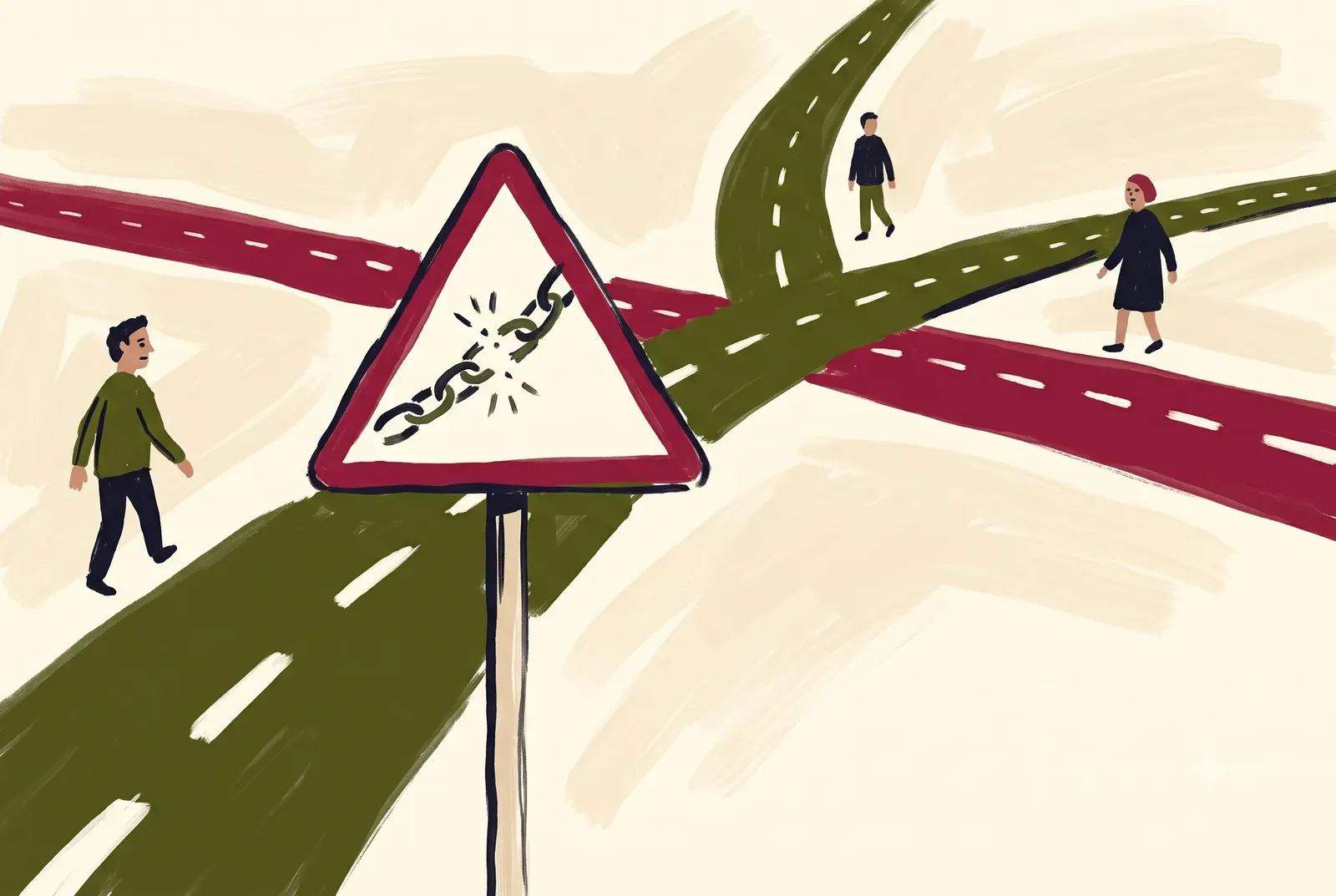
The tools are not the bottleneck. People, operating rhythm, and change management are the defining challenge of AI adoption.
Ashleigh Greaves · 12 March 2026
2026 AI Predictions - Part 2 of 4
The tools are not the bottleneck.
The people and organisational design around them are.
In the first post in this series, I made the case that most businesses are further behind on AI adoption than they are willing to admit. But even among the businesses that are making progress, deploying tools, building workflows, running pilots, a different problem is emerging.
The technology works. The organisation around it does not.
The rise of non-technical orchestration
There is a shift happening that does not get enough attention.
The next wave of AI value will not come from more code or more developers. It will come from non-technical leaders orchestrating AI agents across how they think, prepare, research, and decide.
This is not a theoretical prediction. It is already showing up.
At a hackathon in London earlier this year, the room was not filled with engineers. It was filled with professionals, marketers, operations leads, consultants, and founders who had never used tools like V0, Loveable or Intercom. They were not there because they wanted to become developers. They were there because they wanted to understand what AI could do for their work. How to speak to AI, what questions to ask, how to prompt.
What stood out was not what they built. It was how they showed up. They were transparent about what they did not know. There was no pretence, no performance. They asked basic questions without embarrassment and learned faster because of it.
In ecosystems where there is more pressure to appear technically capable than to admit you are still learning, adoption slows. That dynamic is not unique to any one country, but it is real, and it matters more than most people think. The businesses and cultures that normalise saying "I do not know this yet" will adopt AI faster and more durably than those where people feel they need to perform competence.
The broader point is this: AI agents are becoming useful enough that the ability to orchestrate them, to direct them across thinking, research, synthesis, memory, and preparation, is becoming a genuine skill. And that skill does not require a technical background. It requires clarity of thought, good judgment, and the willingness to learn.
This is already happening at the individual level. People are using AI to launch businesses, expand into new roles, and build capabilities they did not previously have. The next step is when leaders apply that same orchestration instinct across teams, not just their own work.
The best AI systems will not just answer questions. They will ask better ones, at the right time, with the right context. The leaders who learn to work with them that way will have an extraordinary advantage.
Change management is the real failure point
Now for the harder truth.
In 2026, AI will increasingly be blamed for layoffs, restructures, and role changes. Sometimes that will be legitimate. Often it will be cover for decisions that were coming regardless.
But the deeper issue is not whether AI causes disruption. It is that change management will lag far behind technical capability in most organisations.
The technology is moving fast. Organisational design is not keeping up. Most businesses have not yet:
- Rethought how their org structure works in an AI-enabled world
- Defined how humans and AI collaborate on decisions, rather than just automating tasks
- Considered how early-career roles fundamentally change when AI becomes a default collaborator from day one
Think about what is coming:
- Junior hires will manage AI agents as part of their core responsibilities from the moment they start. The concept of "learning the ropes" by doing repetitive work will diminish. What replaces it?
- "Analyst" roles will shift toward decision coordination, synthesising AI-generated insight, applying judgment, and recommending action rather than producing the analysis themselves
- Management skills, judgment, prioritisation, communication, accountability -- will be required earlier in careers than ever before, because AI compresses the time between information and decision
Without intentional design, AI adoption will feel chaotic and threatening to the people inside the organisation, even when it is objectively productive. That is not a technology problem. It is a leadership and design problem.
Consider a legal team that deploys an AI contract review tool. The technology works. But nobody has defined whether the lawyer is reviewing the AI's output or the AI is reviewing the lawyer's. That ambiguity is not a training gap. It is a design gap. And it is playing out across every function where AI is being introduced.
The businesses that succeed will be the ones that treat AI adoption as an organisational design exercise, not an IT rollout. That means mapping how each role changes with AI, not just which roles use AI tools. Defining clear accountability boundaries between human judgment and AI output. Investing in capability building before deployment, not after. Most businesses are skipping straight to tool rollout and calling it transformation.
Change management has always been hard. AI makes it harder, because the pace of change is faster, the scope is broader, and the anxiety is higher. But it also makes it more important. The organisations that get this right will pull ahead. The ones that treat it as an afterthought will struggle, regardless of how good their technology is.
The question to sit with
If your organisation deployed AI across every team tomorrow, would your people know how to work with it? Not how to use the tools, how to work with it. How decisions change. How their roles evolve. What they are accountable for and what the AI is accountable for.
If the answer is not clear, that is your bottleneck. And it has nothing to do with technology.
Get The Brief in your inbox
New AI thinking for business, straight from our team. We only send when we've got something worth your time.